
The 2026 Best Aluminium Door And Frame Manufacturers Guide begins with a practical question: what makes a manufacturer dependable? Buyers now examine thermal performance, fabrication accuracy, recycled content, testing records, and after-sales support. A polished showroom is not enough. A poorly aligned corner can expose weak quality within months.
The International Aluminium Institute’s 1.5°C scenario expects global aluminium demand to grow by about 80% by 2050. Its findings place stronger pressure on manufacturers to improve energy efficiency, recycling, and supply-chain transparency. The International Energy Agency also reports that aluminium production creates roughly 270 million tonnes of direct carbon dioxide emissions annually. These figures make material sourcing part of product quality, not merely a marketing detail.
Materials specialist Chris Lefteri has stated that aluminium can be recycled repeatedly without losing its essential properties. That principle supports durable door systems, but it does not solve every problem. Recycled content, alloy selection, coating quality, and factory controls still matter. Industry reports also use different market definitions, so comparisons can be imperfect. This guide recognises that limitation.
It evaluates leading manufacturers through documented experience, technical capability, certifications, project evidence, and customer service. Readers will see how slim profiles, insulated frames, powder-coated finishes, and precision hardware perform in real buildings. We also consider regional standards and climate conditions. Coastal air, heavy rain, and intense sunlight can expose weak finishes quickly. The strongest Aluminium Door And Frame manufacturers combine engineering discipline with honest environmental reporting. Reliability begins where attractive claims end.
Aluminium door and frame manufacturing begins with the right alloy and profile design. Common architectural systems use 6063 aluminium because it offers clean extrusion and reliable surface finishing. Thermal-break frames include reinforced polyamide strips between the inner and outer sections. This reduces heat transfer, but it does not replace correct glass selection or installation.
Manufacturing usually involves billet heating, precision extrusion, cooling, cutting, CNC machining, and final assembly. Each stage needs inspection. A two-millimeter cutting error can affect corner alignment and gasket pressure. Surface treatments may include anodizing or powder coating. Coating thickness, color consistency, and adhesion should be checked before delivery. Welding is less common for visible frame corners, where crimped or mechanically joined connections often provide a cleaner result. Testing should cover air permeability, water tightness, wind resistance, operation, and drainage. EN 14351-1, ASTM methods, or local standards may apply, depending on the project location.
Tips: Request material certificates, profile drawings, coating records, and test reports. Confirm tolerances in writing. Visit the production line if possible. Look closely at corner joints and drainage holes. Small details matter. Some specifications appear impressive but remain difficult to verify. Manufacturers should explain limitations honestly, especially when thermal performance depends on glass, seals, hardware, and installation quality. A reliable factory also keeps traceable inspection records, though records alone cannot replace practical sampling and site feedback.

In 2026, evaluate aluminium door and frame manufacturers through verified performance, not attractive catalogues. The IEA reports that buildings consume about 30% of global final energy and produce roughly 26% of energy-related emissions. This makes thermal performance a procurement issue, not a decorative feature. Request independently tested U-values, air leakage, water resistance, wind-load results, and thermal-bridge details. Check the test standard, laboratory, date, and tested configuration.
Factory capability matters just as much. Inspect extrusion storage, powder-coating controls, corner-crimping equipment, glazing lines, and final inspection records. Ask how rejected profiles are tracked. A reliable manufacturer should provide batch numbers, production tolerances, installation instructions, and a clear warranty process. The 2023 Global Status Report for Buildings and Construction highlights continuing pressure to reduce embodied carbon, so request recycled-content evidence and environmental product declarations where available. Claims without documents deserve caution.
Do not judge capacity by machinery alone. Compare recent delivery records, sample approvals, packaging quality, and after-sales response times. A small pilot order can expose problems with drainage, gaskets, colour consistency, or hardware alignment. No factory scores perfectly. I would record weaknesses openly, rather than hiding them behind a weighted spreadsheet. Also check whether the proposed system matches local codes and site exposure. A frame that performs well in a laboratory may fail after poor installation. That uncomfortable gap needs attention.
2026 Best Aluminium Door And Frame Manufacturers Guide
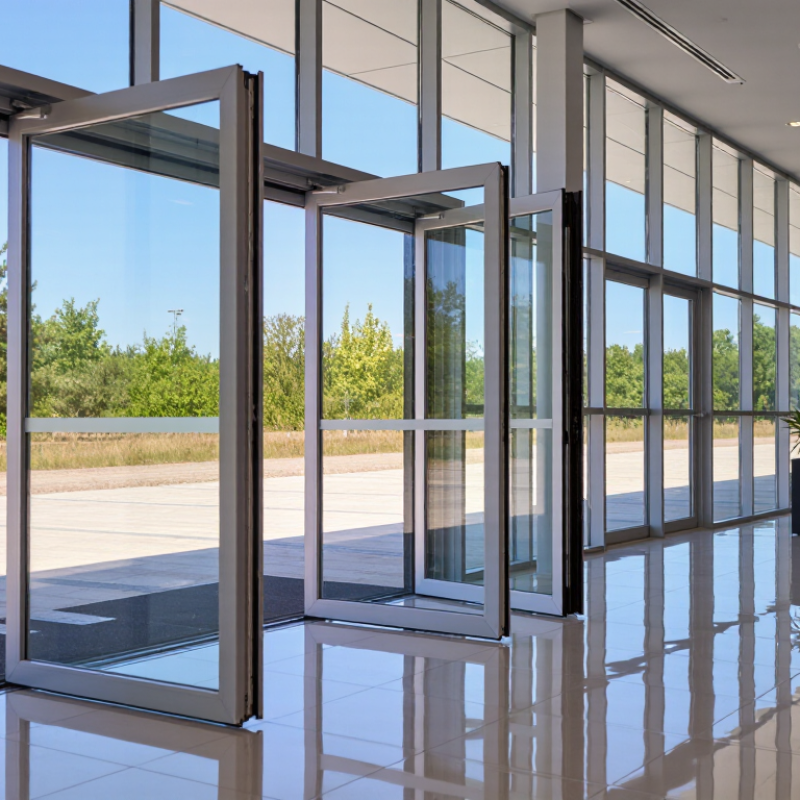
Choosing aluminium doors and frames starts with product type, not appearance. Sliding systems suit wide openings, while hinged doors offer simpler sealing and familiar operation. Folding doors create flexible openings, but their hardware needs careful alignment. Lift-and-slide models can carry larger glass panels with less operating effort.
Design details affect daily performance. Slim profiles increase daylight, yet they may reduce space for insulation and drainage. Thermal-break frames limit heat transfer through the aluminium. Low-emissivity double or triple glazing can improve indoor comfort. Look for adjustable rollers, corrosion-resistant hardware, and replaceable seals. Small details matter.
A reliable manufacturer should provide tested air, water, wind, thermal, and acoustic data. Ask for installation drawings, glass specifications, warranty terms, and maintenance guidance. Factory quality control also matters; uneven corners or poorly fitted gaskets can undermine an excellent design. I have seen attractive doors fail because installers ignored the sill drainage path. The frame was not the real problem.
Powder-coated finishes offer many colour options and resist routine weather exposure when properly applied. Anodized surfaces provide a distinct metallic appearance, though scratches can be difficult to repair invisibly. Recycled aluminium may reduce material impact, but its sourcing and certification should be verified. No system fits every building. A quieter, better-insulated door may require deeper frames, stronger hardware, and a higher budget.
| Product Type | Typical Configuration | Common Design Options | Typical Thermal Performance | Typical Weather Performance | Recommended Applications |
|---|---|---|---|---|---|
| Thermally Broken Hinged Door | Single or double leaf; insulated aluminium profiles with polyamide thermal barriers | Flush panels, glazed panels, slim sightlines, inward- or outward-opening leaves | Door U-value commonly about 1.0–1.8 W/m²K with insulated panels and low-emissivity glazing | Air permeability up to Class 4; water tightness commonly up to Class 7A; wind resistance commonly up to Class C4, subject to size and testing | Residential entrances, apartments, offices, schools, and low- to mid-rise commercial buildings |
| Lift-and-Slide Door | Large glazed panels running on reinforced rollers; two- or multi-track systems | Minimal frames, recessed tracks, corner openings, fixed or operable corner sections | Whole-door U-value commonly about 1.0–1.8 W/m²K, depending on glass, frame size, and panel configuration | Air permeability commonly up to Class 4; water tightness often rated around 6A–8A; wind resistance commonly up to Class C3–C4 | Patios, balconies, luxury residences, hotels, restaurants, and indoor-outdoor living areas |
| Bi-Fold Door | Two or more hinged leaves folding to one or both sides; top-hung or bottom-rolling designs | Odd or even panel layouts, traffic doors, low thresholds, open-corner arrangements | Whole-door U-value commonly about 1.3–2.0 W/m²K with insulated profiles and double or triple glazing | Air permeability commonly Class 3–4; water tightness commonly 4A–7A; wind resistance commonly Class C2–C4 | Extensions, garden rooms, hospitality venues, retail spaces, and wide exterior openings |
| Sliding Patio Door | Horizontally sliding glazed sashes with two- or three-track frames | Narrow interlocks, concealed drainage, flush or low thresholds, fixed side panels | Whole-door U-value commonly about 1.4–2.2 W/m²K, depending on frame depth and glazing | Air permeability commonly Class 3–4; water tightness commonly 3A–7A; wind resistance commonly Class C2–C4 | Housing projects, balconies, terraces, conservatories, and moderate-width openings |
| Commercial Storefront Door | Single or paired doors integrated into shopfront framing; narrow, medium, or heavy-duty sections | Full-height glazing, panic hardware, transoms, sidelights, automatic operators, robust kick plates | U-values commonly about 1.8–3.0 W/m²K; insulation depends strongly on profile and glass selection | Air permeability commonly Class 2–4; water tightness commonly 2A–6A; wind resistance commonly Class C1–C3 | Retail entrances, offices, healthcare buildings, airports, and public facilities |
| Automatic Sliding Door | Sensor-operated single-slide, bi-parting, or telescopic leaves with powered operators | Breakout function, access control, safety sensors, framed or semi-frameless glazing | U-values commonly about 1.6–2.8 W/m²K, with performance affected by frequent opening cycles | Air and water ratings vary by operator and frame system; select products tested to EN 16361 and relevant safety standards | Supermarkets, hospitals, hotels, airports, offices, and accessible public entrances |
| Fire- and Smoke-Resistant Door Set | Insulated aluminium door and frame assembly with tested glazing, seals, hardware, and closers | Single or double leaf, vision panels, panic hardware, access control, powder-coated finishes | Thermal performance is secondary to certified fire integrity and insulation; values depend on the tested assembly | Fire classifications commonly include EI30, EI60, or higher where tested; smoke-control capability must be separately certified | Stairwells, corridors, escape routes, plant rooms, commercial buildings, and public infrastructure |
| Security and Entrance Door | Reinforced hinged door with multi-point locking, security glazing, and strengthened hinges | Solid or glazed leaf, electronic access, concealed closers, anti-finger-trap details, low threshold | Door U-value commonly about 1.2–2.0 W/m²K with insulated panels or high-performance glazing | Security classes RC2–RC3 are common for tested systems under EN 1627; weather ratings depend on the complete door set | Apartments, detached homes, offices, data rooms, retail premises, and controlled-access buildings |
| Aluminium Window and Door Frame System | Fixed, casement, tilt-and-turn, or combined frame assemblies used with compatible door leaves and glazing | Flat or contoured profiles, concealed drainage, integrated mullions and transoms, modular elevations | Frame Uf-values commonly range from about 1.0–2.5 W/m²K; complete Uw or Ud values depend on glazing and installation | High-performing systems may achieve air Class 4, water Class 9A, and wind Class C4–C5 when correctly fabricated and installed | Curtain-wall interfaces, residential windows, office façades, schools, hotels, and mixed-use developments |
Choosing an aluminium door and frame manufacturer in 2026 requires evidence beyond a polished catalogue. Factory experience matters. Ask for batch records, alloy grades, coating thickness, and test results. A small but revealing test is traceability from billet to finished frame.
ISO’s 2023 Survey reports more than one million ISO 9001 certificates worldwide. Certification helps, but it does not guarantee every installation. Check whether the factory controls extrusion tolerances, corner joints, gaskets, glass compatibility, and final inspection. Request independent reports for air permeability, water tightness, wind resistance, and thermal performance. The certificate may be valid. The product can still fail on site.
Customization should follow measured performance, not appearance alone. Frame depth, thermal breaks, drainage paths, hardware loads, and local climate must be reviewed together. The IEA’s Buildings 2023 report links buildings with about 30% of global final energy demand. Poor frame detailing can increase heat loss and condensation. Custom shop drawings, BIM files, color samples, and mock-up testing reduce expensive revisions, although even experienced teams sometimes miss site tolerances. That weakness deserves an honest review.
Technical support should include installation manuals, response targets, replacement parts, and commissioning guidance. Ask who solves problems after delivery. A reliable supplier explains limitations clearly and records corrective actions. UNEP’s 2023 Global Status Report identifies buildings and construction as responsible for roughly 37% of energy-related emissions, making documented thermal and material decisions increasingly important.
Choosing an aluminium door and frame manufacturer in 2026 requires more than comparing catalogue prices. Aluminium costs follow energy, billet, alloy, and freight movements. The World Bank Commodity Markets Outlook shows continued volatility in base-metal prices, so fixed quotations need clear validity periods. Ask whether prices include thermal breaks, glazing preparation, finishes, packaging, and installation support. A low unit price may hide expensive redesigns.
Lead time should be measured from approved drawings, not from the purchase order. For standard profiles, four to eight weeks may be realistic; custom dies, large quantities, or special finishes can extend delivery considerably. Request a milestone schedule covering drawing approval, extrusion, coating, assembly, inspection, and dispatch. The International Aluminium Institute reports that recycled aluminium requires about 5% of the energy used for primary production. Therefore, ask for recycled-content evidence, electricity data, and product-level carbon information, not vague “green” claims.
Tips: Compare three written quotations. Check Incoterms, warranty limits, and replacement procedures. Request samples of corner joints and powder coating. Visit a production site if possible. The Aluminium Stewardship Initiative’s standards can support checks on responsible sourcing and environmental management. One practical weakness remains: supplier promises often sound more precise than factory capacity. Keep a contingency window. Sustainability also deserves skepticism; recycled content alone does not prove a lower whole-life impact when transport, durability, and maintenance are ignored.
Indicative pricing, lead times, sustainability, and supplier-selection benchmarks for aluminium door and framing systems.
Prices are indicative 2026 procurement ranges in USD per square metre and vary by specification, quantity, glazing, finish, certification, and destination. Lead times represent typical production and delivery ranges after approved drawings. Recycled aluminium can require about 95% less energy than primary aluminium, making verified recycled content and documented chain-of-custody important supplier-selection criteria.
We serve the Greater Milwaukee area: Waukesha, Milwaukee, Washington, Ozaukee Counties and nearby areas, including Germantown, Menomonee Falls, Mequon, Cedarburg, Thiensville, Grafton, Jackson, West Bend, Hartland, Waukesha, Brookfield, West Allis, Franklin, Greenfield and more. We are Wisconsin’s Best Contractor for Replacement Windows, Doors, Siding & Roofing!
Address:
N112 W14880 Mequon Road
Germantown, Wisconsin 53022
Phone:
Email:
Monday: 9am – 5pm
Tuesday: 9am – 5pm
Wednesday: 9am – 5pm
Thursday: 9am – 5pm
Friday: 9am – 4:30 pm
Saturday by Appointment
Evenings by Appointment